


 917.475.6839
 November 13, 2025
  Tags:
Tags: 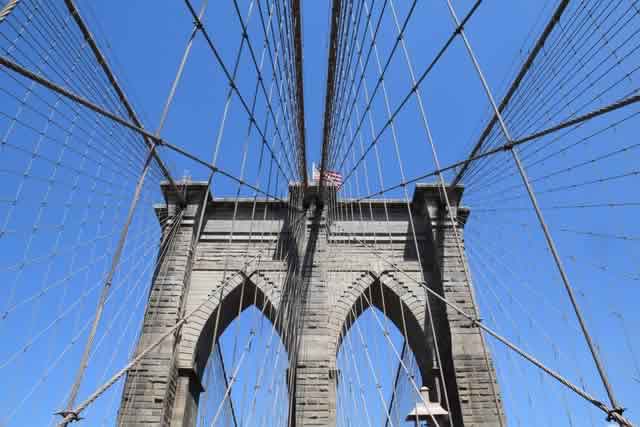
The Remarkable Roeblings and the Making of the Brooklyn Bridge
Few landmarks embody New York’s spirit of ambition and ingenuity like the Brooklyn Bridge. Completed in 1883, this engineering marvel linked Manhattan and Brooklyn for the first time, transforming both cities and shaping the destiny of the young nation. Behind this iconic achievement stood three extraordinary figures—John A. Roebling, Colonel Washington Roebling, and Emily Warren Roebling—whose combined brilliance, perseverance, and sacrifice made the impossible possible. Their story is a central highlight of our Best of Brooklyn/Brooklyn Revolution The Best of Brooklyn Walking Tour, where we explore how the fight for freedom, innovation, and identity continued long after the American Revolution.
John Roebling: The Visionary Engineer
German-born engineer John A. Roebling was already renowned for his pioneering wire-rope suspension bridges, such as the Cincinnati-Covington Bridge, when he proposed a bold new project in the 1860s: a massive suspension bridge stretching across the East River. His design was revolutionary—using steel cables (a Roebling innovation) and Gothic stone towers that would become two of the nation’s most iconic architectural symbols. Roebling envisioned the bridge not just as a feat of engineering, but as a unifying civic triumph that would link the rapidly growing city of Brooklyn with the commercial powerhouse of Manhattan.
Tragically, Roebling never saw construction begin. A crushing accident on the Brooklyn pier led to his death in 1869. But his vision lived on through his son.
Washington Roebling: The Relentless Builder
Colonel Washington Roebling, trained by his father and battle-tested as a Civil War officer, took command of the project at the age of 32. Under his leadership, the team constructed the massive underwater caissons—giant wooden chambers pressurized with air—that allowed workers to dig the foundations of the bridge’s towers deep into the riverbed.
This work came at a tremendous cost. Many laborers suffered from “caisson’s disease,” but Washington himself became the most famous victim. The illness, now understood as decompression sickness, or “the bends,” left him partially paralyzed and confined to his Brooklyn Heights home. Conventional leadership became impossible. But the project did not stop.
Emily Roebling: The Bridge’s Unsung Hero
In stepped Emily Warren Roebling, whose role became legendary. Emily served as Washington’s eyes, ears, and voice on the construction site. She mastered the most complex engineering concepts, relayed her husband’s instructions, negotiated with politicians, and reassured skeptical investors. For over a decade, Emily became the indispensable link that kept the story of the Brooklyn Bridge alive.
When the bridge finally opened on May 24, 1883, Emily rode across it in a ceremonial carriage—the first person ever to cross the finished span.
Explore the Roeblings’ Legacy on the Brooklyn Revolution Tour
The story of the Brooklyn Bridge is about more than cables and towers; it’s about family, resilience, and the evolution of America’s ideals. On our Best of Brooklyn/Brooklyn Revolution Tour, we trace the neighborhood’s history from the Revolutionary era to the Roeblings’ soaring 19th-century achievement. You’ll stand near Washington Roebling’s residence, see key viewpoints of the bridge, and discover how Brooklyn’s spirit of innovation connects the fight for independence with the triumph of one of the world’s greatest engineering feats. You’ll also visit DUMBO, Brooklyn Heights, and Brooklyn Bridge Park with fantastic vistas and American history from the Revolutionary War to the Civil War and beyond. You’ll see New York City in a new way!
Join us and experience the Best of Brooklyn/Brooklyn Revolution Walking Tour.