
Category: Seneca Village

The Secret North: Hidden Beauty in Central Park’s Quietest Corners

Discover Central Park’s hidden northern wonders — from the wild North Woods and tranquil Pool to the elegant Conservatory Garden and scenic Harlem Meer. Join Revolutionary Tours NYC for the Secret Places of Central Park Tour and uncover the park’s most peaceful and historic corners.


The Secret North: Hidden Beauty in Central Park’s Quietest Corners

Most visitors to Central Park never make it north of 100th Street. Yet some of the park’s most enchanting, mystical, and least-visited landscapes lie beyond it — places where the city seems to melt away, and Olmsted and Vaux’s grand design reveals its most intimate secrets. On our Secret Places of Central Park Tour, we explore these northern gems, where history, artistry, and nature intertwine in surprising ways.

The North Woods – New York’s Wilderness

The North Woods feels like a wilderness transported to Manhattan. Designed to evoke the Adirondacks, it’s a landscape of towering oaks, rustic bridges, and a tumbling stream known as the Loch, winding its way toward Harlem Meer. During the park’s construction between 1858 and 1873, nearly 20,000 workers, many of them Irish and German immigrants, reshaped this rugged terrain by hand. They blasted through bedrock, diverted water through dozens of miles of underground pipes, and planted thousands of trees to create this illusion of natural wilderness. Today, the North Woods remains one of the most peaceful refuges in the entire city — a place where you can hear woodpeckers instead of traffic and follow winding trails that reward the curious wanderer.

The Pool – A Serene Hidden Mirror

Just west of the Woods lies the Pool, a tranquil body of water at 100th Street and Central Park West. It’s one of the park’s loveliest and most overlooked features, surrounded by willows and red maples that reflect perfectly in the water’s surface. In spring and fall, migratory birds rest here, while in winter, the scene turns into a snow-dusted tableau worthy of a painting. The Pool captures Olmsted and Vaux’s genius for designing spaces that look entirely natural yet were painstakingly crafted to offer changing beauty with each season.

The Conservatory Garden – A Formal Oasis

A few blocks east at Fifth Avenue and 105th Street stands the Conservatory Garden, a masterpiece of horticultural artistry hidden behind the ornate Fifth Avenue Vanderbilt Gate. Divided into three distinct styles — Italian, French, and English — this six-acre garden bursts with color and structure from the spring through the fall. It’s one of the park’s quietest corners, missed by even seasoned New Yorkers. Whether it’s the symmetry of the Italian terrace or the romantic Secret Garden of the English area, every section reveals another layer of Central Park’s personality — cultivated, elegant, and serene.

Harlem Meer – The Park’s Northern Lake

At the park’s northeast edge lies Harlem Meer, a shimmering lake bordered by elms and willows and framed by a view of Harlem’s skyline. The word Meer means “lake” in Dutch, a nod to the area’s early colonial history. In Olmsted and Vaux’s design, the Meer served as both a picturesque water feature and a recreational gathering place. Today, it remains one of the park’s most tranquil settings — perfect for birdwatching, or simply standing by the shore as the light ripples across the water. The Meer represents the ideal balance between nature and city — the kind of harmony Central Park was built to create.

Discover the North with Us

These northern landscapes and other areas of the areas of the northern park tell a quieter story of Central Park — one of tranquility, mystery, and discovery. On our Secret Places of Central Park Tour, you’ll explore these hidden sanctuaries, uncover the history behind their design, and experience a side of the park most visitors never see.

Best Central Park Walking Tour in New York City

Seneca Village: A Remarkable African American and Immigrant Community

Seneca Village Tour in Central Park

In the heart of what is now the Central Park landscape once stood Seneca Village, a vibrant and empowered African American and immigrant community that existed on the land between 1825, two years before the end of slavery in New York State, and 1857.  The community was between 82nd and 89th Streets and between Seventh and Eighth Avenues.  Seneca Village was established when white property owners John and Elizabeth Whitehead, uptown landowners, subdivided their property and sold off 200 lots. The first buyer was Andrew Williams, a 25-year-old African American bootblack (shoe shiner) who purchased three lots for $125.  Williams was soon joined by others seeking opportunity and refuge from the crowded, disease-ridden, and discriminatory conditions of Lower Manhattan. Epiphany Davis, a store clerk, bought 12 lots for $578, and the African Methodist Episcopal Zion Church acquired six more.  By the mid-1850s, it had grown to around 50 homes, three churches, a school for African-American children, and burial grounds. White European immigrants began moving to Seneca Village in the 1840s.

Seneca Village was remarkable not just for its growth but for its diversity and autonomy. At its peak, the community numbered about 225 residents, two-thirds of whom were Black, with the rest being Irish and possibly German immigrants. More than half of the Black residents were property owners, a rare achievement since, at the time, only 10% of the city’s entire population owned land.  This land ownership also conferred the right to vote for Black men (a $250 property-ownership requirement and three years’ residency in the state began in 1821), as well as stability and self-determination.

Andrew Williams, the village’s first landowner, lived there with his wife, Elizabeth, and their family from 1825 until 1857, when the city acquired the land through eminent domain to create Central Park. Williams’s story is emblematic of the community: he built a home, raised a family, and participated in a thriving middle-class neighborhood that included churches, schools, and gardens.  Epiphany Davis, another prominent resident, invested in multiple lots and helped anchor the village’s economic and social fabric.

The landscape of Seneca Village was varied, featuring rolling hills, rocky outcrops, and meadows. Residents cultivated gardens, raised livestock, and drew water from a natural water source that became known as Tanner’s Spring, while orchards and barns dotted the landscape.

Seneca Village offered a rare sanctuary of Black property ownership and community in antebellum New York. Its erasure in 1857 for Central Park’s creation was a profound loss, but ongoing research, archaeological work, and public commemoration since it’s rediscovery in 1992—by historians Roy Rosenzweig and Elizabeth Blackmar—are restoring its rightful place in the city’s history—a testament to resilience, aspiration, resourcefulness, and community in the face of adversity.  Find more about Seneca Village on the Secret Places of Central Park and Central Park Experience walking tours, as well as a private tour focusing on Seneca Village offered for groups of adults, students, and corporate employees.

The Appeal for The Central Park

Best Central Park Walking Tour

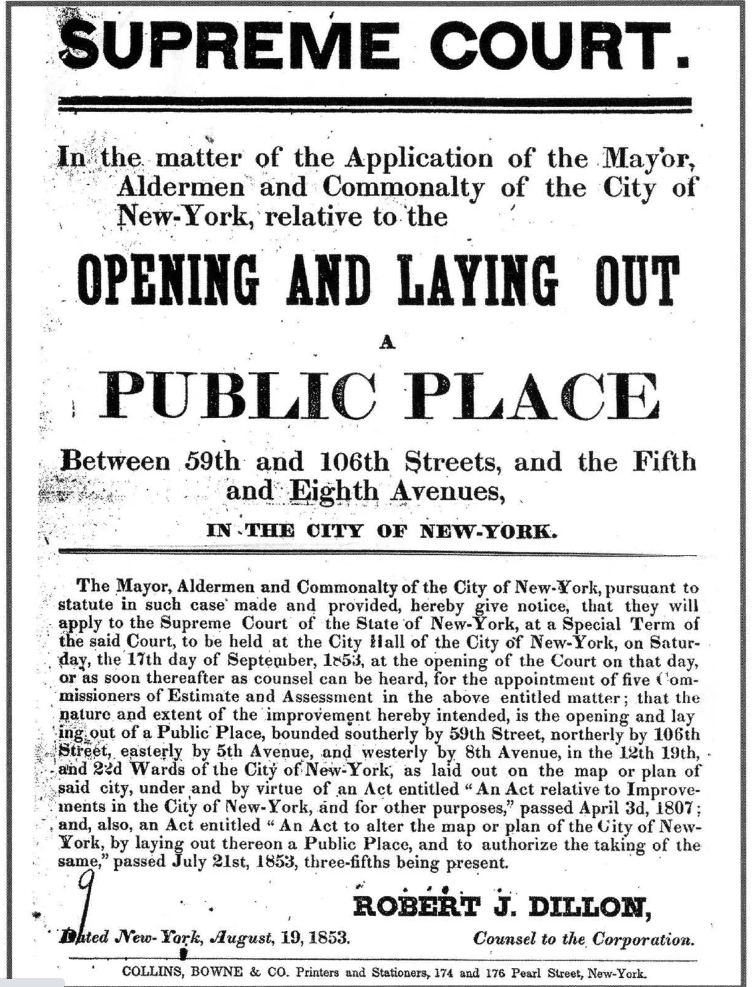
On August 19, 1853, the mayor, aldermen, and commonality of the City of New York announced an appeal to the state’s Supreme Court for the “opening and layout” of a “public place between 59th and 106th Streets and Fifth and Eighth Avenues in the [uptown] 12th, 19th, and 22nd Wards.”[1]  Earnest appeals for a public park first surfaced in 1844, when William Cullen Bryant—poet, journalist, and editor of the New-York Evening Post—called for an “extensive pleasure ground” in New York City, and one that matched “the greatness of our metropolis.”[2]  “Commerce is devouring inch by inch the coast of the island,” Bryant warned, “and if we would rescue any part of it for health and recreation, it must be done now.”[3]  “The only objection which we can see,” he prognosticated, “would be the difficulty of persuading the owners of the soil to part with it.”[4]  That remark proved to be prescient. 

            Four years later, Andrew Jackson Downing echoed the call for a park.  Downing was the foremost landscape designer in the young nation, a drafter of the prodigious grounds of the White House and the Smithsonian, and a contributor to the design of the Washington Mall.  The ambitious Downing also had his designs on New York City.  “What are called parks in New-York,” he scoffed, “are not even apologies for the thing.” [5]  A well-designed park in the divided and frenetic city would, he claimed, “soften and humanize the rude . . . and give continual education to the educated,” and thereby serve all classes.[6]  A park, he noted, could unite the class-conscious and divided city.

            The first plan for an urban oasis in 1853, was a $1.5 million conversion of a 153-acre privately owned plot of land.[7]  Jones Wood, as it was called, was on the East River between Sixty-Sixth and Seventy-Seventh Streets.[8]  It belonged to two affluent families, the Jones and Schermerhorns, so vehemently opposed to a coerced acquisition through eminent domain that they appealed to the courts.[9]  William C. Schermerhorn asserted that eminent domain was a “persecution” of him and his family.[10]  The government’s role, he argued, was to safeguard, not seize his private property.

            A New York County judge declared the bill to acquire Jones Woods unconstitutional.[11]  While some leaders continued their advocacy, others set their sights on a larger, more central location on the border of communities known as Harlem, Bloomingdale, and Yorkville—comprised mainly of immigrants and African Americans.[12]  The 778-acre rugged, swampy land was enormous, more than five times the size of Jones Wood.  Many believed the land could be acquired and converted into a spectacular parkland for roughly the same $1.5 million cost.[13]  Moreover, 135 acres already belonged to the Municipal Corporation of New York, and the rest could be acquired through the state’s right of eminent domain.[14] 

            The new Central Park board insisted that under eminent domain, the “citizen” is protected from “injustice.”[15]  “He is,” they continued,” protected in the enjoyment of his property, unless the public needs it.”[16]  Unlike the Jones and Schermerhorns who fought the surrender of Jones Woods, the African Americans and immigrants inhabiting the future Central Park—including those in Seneca Village—had little access to the court system to fight the justification of that  “need.”


[1] “Handbill declaring the intended construction of Central Park,” in “Seneca Village: A Teacher’s Guide Using Primary Sources in the Classroom,” New-York Historical Society, 2010, 13, Collection of The New York City Municipal Archives, Bureau of Old Records, https://nyhs-prod.cdn.prismic.io/nyhs-prod/05a15797-cc2c-4360-a804-0bae8d3cec80_Seneca_Village_NYHS.pdf.

[2] William Cullen Bryant, “A New Public Park,” Evening Post (New York, NY) July 3, 1844, 2, https://newscomwc.newspapers.com/image/32119902.

[3] Ibid.

[4] Ibid.

[5] Andrew Jackson Downing, Rural Essays (New York: Leavitt & Allen, 1853), 485, Google Books, 2009, https://www.google.com/books/edition/Rural_Essays/MSa8zQEACAAJ?hl=en.

[6] Ibid., 142.

[7] Rosenzweig and Blackmar, Park and the People, 45.

[8] Ibid.

[9] Ibid., 45–49.

[10] Ibid., 50.

[11] Ibid. 50–53.

[12] Ibid., 60; Sara Cedar Miller, Before Central Park (New York: Columbia University Press, 2022), 193, Kindle; “A small branch” of the Methodist African Union met in the area slightly before 1846, but “with no distinct organization” of note. See: Jonathan Greenleaf, History of the Churches of All Denominations in the City of New York (New York: E. French, 1846), 328, HathiTrust, https://babel.hathitrust.org/cgi/pt?id=uc2.ark:/13960/t05x27q2p&view=1up&seq=5.

[13] Rosenzweig and Blackmar, Park and the People, 59.

[14] Ibid., 45; Besides the 135 acres of public land which accommodated a receiving reservoir, the rest belonged to 561 landowners.  Twenty percent of the property belonged to only three families.  The 34,000 lots ended up costing $5 million—more than three times the estimated $1.5 million cost for the entire park, including land and construction. See: Burrows and Wallace, Gotham, 792.

[15] “Report of Special Committee on Public Parks, January 2, 1852,” in First Annual Report on the Improvement of Central Park (New York: Chas. W. Baker, Printer, 1857), 104, Historical Vital Records of New York City, http://nyc.gov/html/records/pdf/govpub/4055annual_report_manhattan_central_park_1857.pdf.

[16] Ibid.