



 917.475.6839

 November 3, 2026
 Tags:
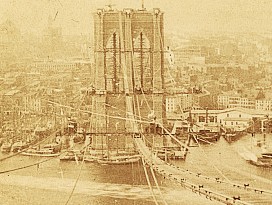
Before you take your first steps across the Brooklyn Bridge, imagine descending beneath the East River into a wooden chamber where compressed air keeps the water out. Above you, a massive stone tower is taking shape. Your job is to excavate the riverbed beneath it.
The story of building the Brooklyn Bridge begins here: underwater, under pressure, and with dangers its builders did not fully understand.
A Dream Connecting Two Cities
Before the bridge opened, Manhattan and Brooklyn were separate cities, with ferries carrying people and goods across the East River. Engineer John A. Roebling envisioned a permanent connection on a breathtaking scale. When completed, his bridge would have the longest suspension span in the world.
But Roebling would never see it rise. In 1869, his foot was crushed in an accident at the bridge site. He subsequently died of tetanus, leaving his son, Washington Roebling, to carry the enormous undertaking forward. A project intended to transform urban life had already transformed one family’s future.
The Dangerous World Beneath the River
The bridge’s soaring towers depended on work that pedestrians would never see. Workers excavated inside pneumatic caissons: enormous chambers supplied with compressed air that created underwater working spaces. As workers removed sand, gravel, and boulders, the caissons descended, making possible the foundations that would support the towers.
Yet this ingenious technology carried a terrible risk. Workers could develop decompression sickness, then called “caisson disease,” after exposure to the pressurized environment. Washington himself became seriously ill. By 1872, Washington Roebling’s health threatened his ability to oversee construction in person.
Think about that the next time you pause beneath a tower’s stone arches: this familiar New York City landmark rests on an extraordinary human struggle.
Emily Warren Roebling Steps Forward
At this critical moment, Emily Warren Roebling became indispensable. She studied Washington’s plans, copied specifications, and explained his instructions to assistant engineers. She also met with engineers, negotiated details with contractors, and communicated with the bridge’s trustees.
Her contribution demanded technical understanding and political skill. When some trustees sought to replace Washington in 1882, Emily successfully defended his position. Washington remained chief engineer, supported by a woman whose knowledge and determination helped bring the bridge to completion.
Spinning a Path Across the Sky
Above the river, another remarkable process unfolded. The main cables were formed by carrying individual wires across the span, gathering them into bundles, and wrapping them into solid cables. The bridge combined monumental masonry with pioneering steel-wire technology—a daring marriage of weight and tensile strength.
On May 24, 1883, the Brooklyn Bridge opened, turning an audacious proposal into a working connection between two cities.
Today, walking across the Brooklyn Bridge offers more than spectacular views. Look upward at the cables, downward toward the river, and back toward those immense towers. Each reveals another chapter of Brooklyn Bridge history.
Join Revolutionary Tours NYC on a Brooklyn walking tour to experience the bridge and the surrounding neighborhoods through the stories of the people who helped shape them.


