
Tag: Brooklyn Bridge Tour

How the Brooklyn Bridge Was Built—and Why It Remains an Engineering Wonder

Best Brooklyn Walking Tour

When the Brooklyn Bridge opened on May 24, 1883, it was more than a new route across the East River. It was the longest suspension bridge in the world, the first permanent connection between the then-independent cities of Brooklyn and New York, and a breathtaking demonstration of what American engineering could accomplish.

Building it required 14 years, approximately $15 million, and the persistence of three remarkable members of the Roebling family.

A Bridge Many Believed Could Not Be Built

By the mid-nineteenth century, Brooklyn and Manhattan were expanding rapidly, but the East River could only be crossed by ferry. Ice, fog, congestion, and severe weather frequently disrupted travel. Yet constructing a bridge posed an extraordinary challenge: it had to span a busy tidal waterway without obstructing the masts of ships entering one of the world’s busiest ports.

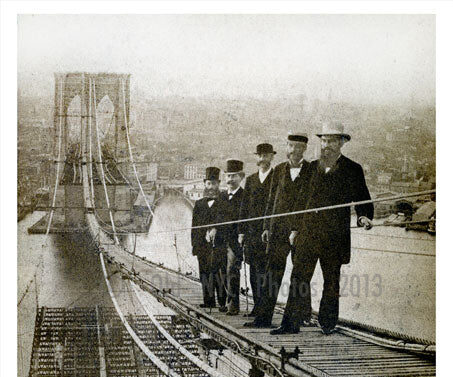
Engineer John A. Roebling proposed an audacious solution—a monumental suspension bridge with a central span of 1,595.5 feet and a roadway rising 135 feet above the river. Its total length, including the approaches, would exceed 6,000 feet. Roebling died from tetanus after an accident near the construction site in 1868, leaving his son Washington Roebling to oversee the project as chief engineer.

Dangerous Work Beneath the East River

The bridge’s enormous granite-and-limestone towers rest upon caissons: vast, bottomless wooden chambers sunk into the riverbed. Compressed air kept water from entering while laborers—often called “sandhogs”—excavated mud, gravel, and rock beneath the structures.

Conditions inside were hot, noisy, and dangerous. Workers emerging too quickly from the pressurized chambers sometimes developed what physicians called “caisson disease,” now known as decompression sickness or the bends. Washington Roebling was among those seriously injured, leaving him unable to supervise construction regularly in person.

His wife, Emily Warren Roebling, became essential to the bridge’s completion. She carried Washington’s instructions to the construction site, communicated with engineers and contractors, maintained records, and mastered technical subjects including cable construction, stress analysis, and the calculation of catenary curves. Her contribution was finally acknowledged during the bridge’s 1883 dedication.

An Engineering Achievement That Changed New York

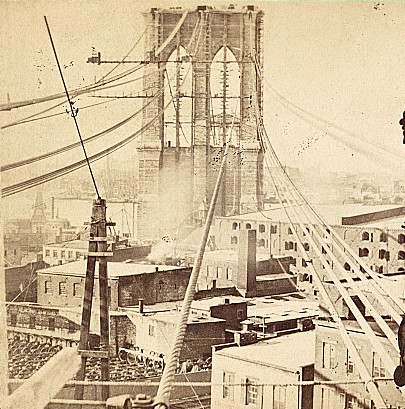
The Brooklyn Bridge pioneered the large-scale use of steel-wire suspension cables. Four immense main cables carried the roadway between its Gothic-inspired towers, while vertical suspenders and diagonal stays added strength and stability. Its elevated pedestrian promenade was also visionary, allowing people to cross above the traffic while enjoying extraordinary views of the New York Harbor and the Manhattan skyline.

The bridge immediately transformed movement between Brooklyn and Manhattan and helped bind the two cities economically and socially—15 years before they became part of a consolidated New York City. Its hybrid suspension system influenced later bridge engineering, while its union of stone, steel, utility, and beauty made it an enduring symbol of New York’s ambition.

Today, millions recognize the Brooklyn Bridge, but far fewer know the human drama behind it.

To experience the bridge where its history unfolded, join our Brooklyn Revolution Walking Tour. Walk across this engineering masterpiece with an experienced New York City historian, hear the remarkable stories of the Roeblings and the people who built it, and discover how the Brooklyn Bridge helped revolutionize New York. Book your Brooklyn Revolution Walking Tour and see one of America’s greatest landmarks with new eyes.

The Best Brooklyn Walking Tour for Unforgettable New York City Views

Best Brooklyn Tour

Some of New York City’s most spectacular views are not found at the top of a skyscraper. They unfold at street level—while crossing the Brooklyn Bridge, strolling through Brooklyn Bridge Park, and standing above the waterfront on the Brooklyn Heights Promenade.

Our Best of Brooklyn Walking Tour brings these extraordinary landscapes to life through the stories behind them. Led by a licensed New York City tour guide and historian with more than 25 years of experience, this immersive Brooklyn history tour explores the Brooklyn Bridge, DUMBO, Brooklyn Bridge Park, and the tree-lined streets of Brooklyn Heights.

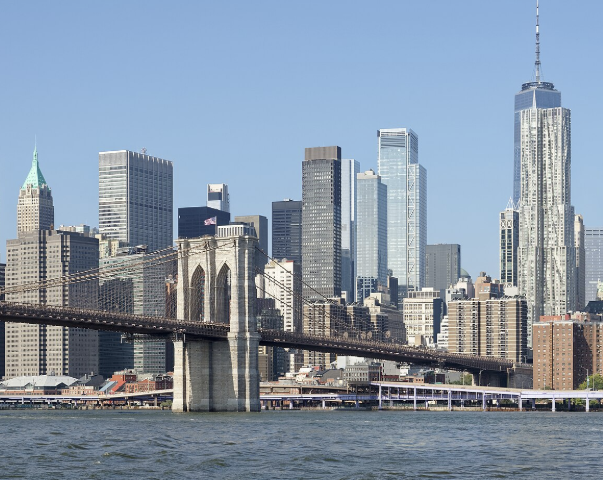
The experience begins with one of the world’s great urban walks: crossing the Brooklyn Bridge from Manhattan to Brooklyn. As the pedestrian walkway rises above the East River, the city gradually opens around you. Look south toward New York Harbor and the Statue of Liberty, west toward Lower Manhattan, and north toward the Manhattan Bridge and the distant Midtown skyline.

Completed in 1883, the Brooklyn Bridge was the longest suspension bridge in the world at the time. Its construction took 14 years and required remarkable innovation—and tremendous human sacrifice. On the tour, you will hear how John A. Roebling conceived the bridge, how his son Washington supervised its construction after his father’s death, and how Emily Warren Roebling became essential to its completion. The bridge is not simply a beautiful place to take photographs; it is one of the great engineering achievements of the nineteenth century.

After reaching Brooklyn, we enter DUMBO, where massive brick warehouses, Belgian-block streets, and former factories recall the neighborhood’s industrial past. Here, the Manhattan Bridge appears dramatically between the buildings, while glimpses of the Brooklyn Bridge frame the waterfront.

The scenery becomes even more expansive in Brooklyn Bridge Park. Created from a former shipping and industrial waterfront, the park provides sweeping views across the East River toward the towers of Lower Manhattan. From its lawns, pathways, and piers, you can watch ferries floating across the harbor and see the Brooklyn Bridge from below—its stone towers rising above the water. The park’s transformation also tells a larger Brooklyn story: how an aging commercial waterfront became one of New York City’s most impressive public spaces.

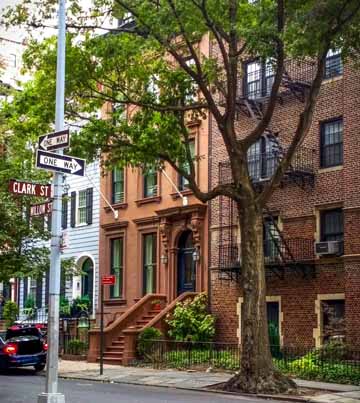
The tour continues into Brooklyn Heights, New York City’s first designated historic district. Its quiet streets are lined with elegant nineteenth-century brownstones, former carriage houses, and churches associated with Brooklyn’s abolitionist history.

The grand finale is the Brooklyn Heights Promenade, an 1,820-foot-long elevated esplanade overlooking Brooklyn Bridge Park, New York Harbor, and the Manhattan skyline. The panorama is considered so important that New York City created a special zoning district to protect it.

This is more than a sightseeing walk. It is a chance to experience the best views in Brooklyn while discovering the history hidden within the landscape. If you are looking for the best Brooklyn walking tour, our historian-led journey offers unforgettable vistas—and the stories that make those vistas meaningful.

Walk through Brooklyn’s scenic panoramas and Brooklyn’s history that helped shape New York City and America. Sign up for the Best of Brooklyn Tour today!

Walk the Brooklyn Bridge with a Historian: The Epic Story Beneath Your Feet

Best Brooklyn Bridge Tour

Walking across the Brooklyn Bridge is one of the unforgettable experiences of New York City. The skyline opens around you. The East River moves below. The stone towers rise ahead like cathedral gates. Cars rush beneath the wooden promenade, while cables sweep upward in dramatic arcs toward the sky.

But when you walk the Brooklyn Bridge with a licensed New York City tour guide and historian, the bridge becomes more than a view. It becomes a story.

On our Best of Brooklyn Walking Tour, every step across the bridge reveals a different chapter in one of the greatest engineering dramas in American history. You will hear how this wondrous bridge connected two separate cities — New York and Brooklyn — and helped shape the modern metropolis we know today.

As you pause beneath the soaring Gothic arches, your guide brings you back to the 1870s, when thousands of workers began building what many considered a miracle of modern engineering. You will imagine the dangerous world beneath the river, where men worked inside massive pressurized chambers called caissons, digging by hand in darkness, heat, mud, and compressed air. Some became terribly ill from what we now call decompression sickness, or “the bends.”

You will also hear the dramatic story of the Roebling family. John A. Roebling, the brilliant engineer who designed the Brooklyn Bridge, died before he could see his vision built. His son, Washington Roebling, took over the project but became seriously ill after working in the caissons. Then came Emily Warren Roebling, whose intelligence, determination, and behind-the-scenes leadership helped carry the bridge to completion.

As Manhattan recedes behind you and Brooklyn draws closer, the bridge’s story becomes even more powerful. This was not just a feat of iron, stone, and cable. It was a symbol of ambition, sacrifice, innovation, and New York’s relentless drive to reinvent itself.

By the time you step off the bridge into DUMBO, you will not just have crossed one of the most famous landmarks in the world, you will understand it. You will see why the Brooklyn Bridge became a defining symbol of New York City — and why walking it remains one of the best things to do in NYC.

Join our historian-led Brooklyn Bridge walking tour and experience the bridge not as a postcard, but as a living story beneath your feet. You will also visit DUMBO, Brooklyn Bridge Park, and the first American suburb, Brooklyn Heights.

Walk through Brooklyn’s history that helped shape New York City and America. Sign up for the Best of Brooklyn Tour today!